
Winster Hall
Winster Hall, Winster, Derbyshire, DE4 2DJ
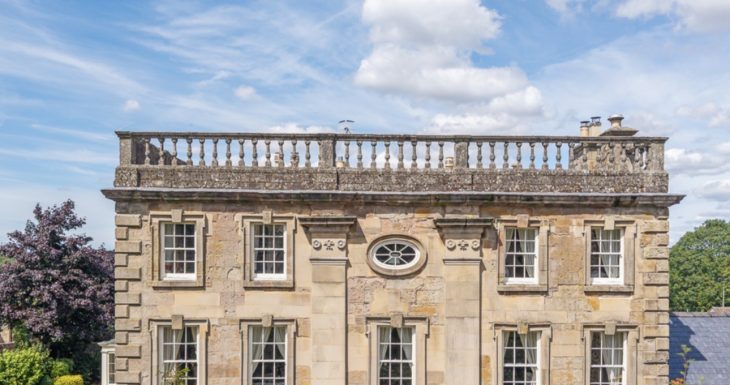
Winster Hall is a Grade II* listed early eighteenth-century house, built c.1700–1724 for Robert Moore, a lead merchant whose wealth reflected the prosperity of Winster during the Peak District’s mining boom. It stands within the Winster Conservation Area, forming part of a tightly grained limestone village shaped by centuries of mineral extraction and incremental growth.
The Hall belongs to a period when Winster was at the height of its economic confidence. Lead mining generated significant local wealth, enabling the construction of substantial stone houses that expressed status and permanence.
The Moore family had earlier roots in the village, with a previous house on the site dating to the seventeenth century. The present Hall represents a deliberate step-change … a more formal, architecturally composed building aligned with contemporary classical taste, interpreted through local craftsmanship.
Architecturally, the Hall is a square-plan, three-storey ashlar gritstone building, with a disciplined five-bay frontage and central emphasis articulated through giant pilasters and a classical doorway.
Internally, the principal rooms retain important elements of the early eighteenth-century decorative scheme. These include a finely crafted fruitwood staircase, reflecting the quality of joinery associated with high-status provincial houses of the period.
Most notably, the Hall contains an exceptionally rare and coherent ensemble of painted ceiling panels, forming part of an early eighteenth-century decorative scheme. Executed in oil on canvas and applied to the ceilings (marouflage), the scheme comprises allegorical and mythological compositions, including representations of Aurora attended by putti, together with subsidiary panels depicting seasonal and symbolic subjects.
The paintings are set within gilded and moulded frames, including shell and foliate ornament, creating an integrated decorative composition typical of the English Baroque tradition. Stylistically, the work is consistent with that produced by provincial artists working within the circle of Louis Laguerre and Antonio Verrio, whose influence extended widely through the Midlands in the period c.1690–1710.
The survival of this scheme in situ is of particular significance. Such decorative schemes were once more widespread but have largely been lost through later alteration or redecoration. At Winster Hall, the paintings appear to have been covered for a prolonged period, which has contributed to their preservation and legibility.
Together, these elements demonstrate a clear intention on the part of the original patron to adopt metropolitan decorative fashions within a provincial context, elevating the Hall beyond vernacular building traditions and aligning it with the broader culture of early Georgian country house design.
Following Robert Moore’s death in 1724, the Hall passed to his son, who died without issue in 1762, bringing the direct Moore line to an end. Thereafter, the property passed into the ownership of the Carrill-Worsley family, including Thomas Carrill-Worsley and later Charles Carrill-Worsley.
Through this line, Winster Hall became connected to one of the most significant families of the period. Charles Carrill-Worsley married Mary Jane Darwin, granddaughter of Erasmus Darwin and cousin of Charles Darwin, establishing a direct link to the Darwin–Wedgwood circle … a network associated with scientific advancement and Enlightenment thought.
During the later nineteenth century, the Hall was home to Llewellynn Jewitt FSA, a Derbyshire antiquary, journalist, and author specialising in archaeology and Wedgwood. During his residence at the Hall, Jewitt produced and edited a substantial body of antiquarian and topographical work, including The Reliquary, The Stately Homes of England, Half-Hours Among English Antiquities, and The Ceramic Art of Great Britain.
Today, Winster Hall continues its long-established residential use. The building remains a living historic house, shaped by over three centuries of occupation, adaptation, and care.
Its significance lies not only in its architecture, but in the continuity of its domestic role within the village. From its origins as the house of a prosperous Derbyshire lead-mining dynasty, through periods of tenancy and changing ownership, the Hall has retained its essential identity as a home, contributing to the enduring character of Winster.