
Haughley Park
Seventeenth-century house on the site of a royal hunting ground attached to Haughley Castle.
Haughley Park, nr Wetherden, Stowmarket, Suffolk IP14 3JY
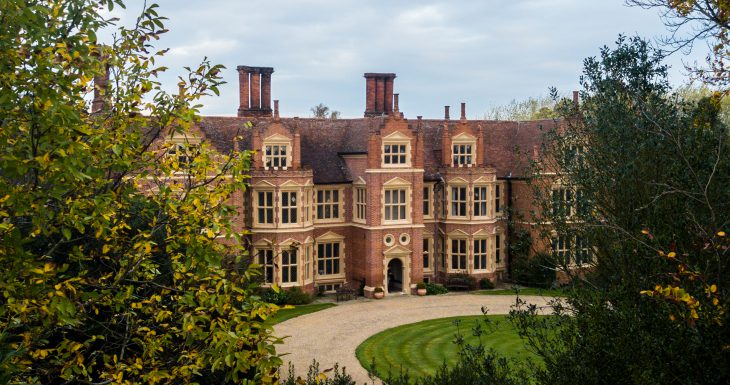
The History: the park and woods are what remains of the hunting ground that formed part of the ‘Honour of Haughley’ bestowed by William the Conqueror on Hugh de Montford after the Conquest. In the later middle-ages the manor of some 2,500 acres was granted to Sir John Sulyard whose descendent of the same name built the house in 1620. In 1818 the estate, then of about 500 acres, was sold to William Crawford, a wealthy London lawyer, and it seems likely that he is responsible for the rebuilding of the north wing of the house, giving it the rounded bays and sash windows on that elevation though respecting the Jacobean style on the east. His son, the Rev. William, built the Farmhouse and added the long west wing and the outbuildings in the stable-yard to the south of the house. Arthur Pretyman bought the estate in 1867 and Mr Turner Henderson in 1924. The land is light, sandy and stoney to the north and more clayey to the south. It is grazed by sheep but probably never farmed.
In 1956, when the main house, Grade 1 listed even then, was threatened with demolition, John Rannoch Ltd bought it on the condition they were granted planning permission to build a new egg and poultry packing station at the rear of the site and to use half the house as the company’s offices and half as a home for the Chairman, Alfred Williams, and family. That purchase included the eastern 67 acres of parkland with the drive and main entrance.
The company bought the Barn and the Farmhouse in 1962.
The rest of the parkland and the whole of the woodland was bought privately by Mr Williams in the early 1960s and on his death in 1994 were put into the Haughley Park Trust. In 2002, JRL, including the factory site, was sold, but the family retained the rest of the estate in Haughley Park Ltd which manages the whole. The estate now consists of about 120 acres of parkland, 100 acres of woodland and 20 acres of gardens, lawns, yards, drives and car parks around the house, barn and farmhouse.
The House restoration began with the south ‘office end’ which was restored and occupied by 1958. The restoration of the private end started in 1959 but during the night of 21st January 1961, when the restoration was nearly complete, a bad fire broke out, perhaps started by the painters’ live-flame blow-lamps. It gutted the interior of that end of the house, though leaving the thick brick outside walls, and tall chimneys, standing. It was insured and there was no option but to start again. The restoration was faithful to the original with some improvements and it won a prize for the quality of the woodwork, particularly the oak staircase. The family moved in in March 1964. Alfred Williams’s son Robert and family have lived in the house since 1994.
The Barn consists of three sections in line. The central Barn is a fine example of a 17th century hay and threshing barn with an original wind-braced timber roof and thick, mellow, red-brick walls. It was probably built soon after the house, in the 1620s. The timber-framed extension known as the Stable End after its previous use, may have already existed because some of its timbers date from before 1500, though they look like re-used ones. The Marriage Room, on the other side of the main barn, is probably 18th century and before conversion was a ventilated, lap-board woodshed.
The Barn buildings were restored in 1977 for use as a venue for company ocasions and for charitable use. It was listed, Grade ll in 1988. Nothing was pulled down and no new buildings added, so, apart from having more windows, the appearance is much as it was in the early 1960s when it was still in use as the farm buildings of Park Farm. Great care is taken to preserve this originality, both outside and inside, which is much of its appeal. In 1987 a bar and toilets were installed in one of the ranges of cart sheds forming the courtyard behind the barn and in 1997 kitchens, storerooms and a workshop were installed in another. The Barn opened for wedding receptions in 2002 and was licensed for Civil Ceremonies in 2003. In 2010 the toilets were re-fitted in a style more suitable for one of Sufolk’s most attractive and successful wedding venues.
The Farmhouse, 70 yards behind the Barn, was built in about 1860 on generous, decorative, Victorian lines. In 2008 it was converted to a 5 double-bedroomed self-catering accommodation with kitchen, dining room, living room and rear boot-room and wet-room. The two front bedrooms have ensuites with shower, basin and lavatory. The two rear bedrooms share a bathroom with bathtub, separate shower, basin and lavatory. The ground-floor bedroom is disabled-friendly with ensuite access to the wet-room when required. In Sept. 2019 the farmhouse roof was repaired and retiled.