
No 1 Royal Crescent
Bath, BA1 2LR
About No.1 Royal Crescent
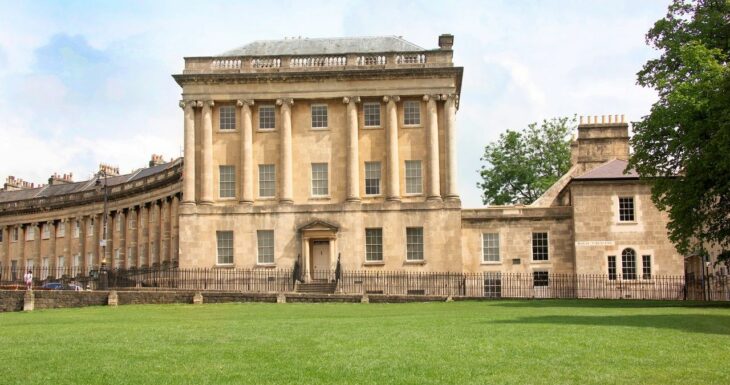
No.1 Royal Crescent, Bath (Grade I listed building) was built to the designs of architect John Wood the Younger (1728-1782) between 1767 – 72. It is the first house in the Royal Crescent (built 1767-75), a Bath stone crescent of thirty houses in the fashionable Palladian style of architecture.
The Royal Crescent is the culmination of the 18th century development of Bath designed by Wood the Younger and his father John Wood the Elder (1705-1754) that also included Queen Square (built 1729-34) and the Circus (built 1754-69). This sequence of spaces combined landscape and architecture to create one of the most significant pieces of town planning in Europe.
The design of the Royal Crescent originally maximised the open view down to the River Avon, which provided those who could afford to live there the sense of being at their country estate while actually residing on the edge of the city. It even included a ha-ha, a one-sided ditch used in country estates to create an invisible fence, to stop animals reaching the upper lawn. Bath continued to expand and the view from the Royal Crescent changed as more of the city was constructed. However, the creation of Royal Victoria Park in 1830 and the small semi-circular Crescent lawn above the ha-ha has allowed the building to retain its view across a more natural setting. To find out more about the architecture of the Royal Crescent and Bath explore the Museum of Bath Architecture website.
No.1 and No.1a Royal Crescent
To the east of the main No.1 Royal Crescent house is a two-storey wing known as No.1a. This was built at the same time as No.1 was being constructed by John Wood the Younger, and was possibly used as a form of ‘site office’ for him and his developer partner Thomas Brock. The eastern No.1a range became the service wing of No.1 and originally had an open courtyard separating the two buildings. In 1769 John Wood the Younger added an extension to No.1, the Gentleman’s Retreat. You can still see the remains of an external staircase from that room as you explore the house today. Wood then created a form of curtain wall at the front connecting both buildings together (now the entrance to the museum shop and exhibition gallery) and later developments integrated the service wing more fully with No.1.
The residents of No.1 Royal Crescent
The occupation of the house reflects the changing social make-up of Bath with a decline in the status of the occupants from a wealthy landowner (Mr Henry Sandford) who rented the house 1776-1796, to clerics and minor gentry. In the 1840s the house was a seminary for young ladies and later became a lodging-house. There were alterations to the plan and features of the house in the 19th century including the removal of the back stairs and the lowering of all first-floor window sills.
The No.1 and No.1a buildings were first formally separated in 1968, when No.1 was bought by Mr. Bernard Cayzer who supported its restoration to become both a historic house and the headquarters for Bath Preservation Trust. No.1a became a separate private residence at that time.
In 2006 No.1a was acquired by the Brownsword Charitable Foundation specifically with the intention of making it available to Bath Preservation Trust on a long-term lease. Preserved within the building are some rare and important kitchen fittings. The two buildings were reunited in 2013 through the Whole Story Project, thanks to the generous support of the National Lottery Heritage Fund, the Brownsword Charitable Foundation and many other Trusts, Foundations and individual donors.
Becoming a museum
When No.1 Royal Crescent was separated from its service wing in 1968 it was bought by Mr. Bernard Cayzer and given to Bath Preservation Trust. At that time Mr Cayzer also provided funds for the restoration of the house in order that it could be opened as a Georgian townhouse museum and could generate income for the campaigning work of Bath Preservation Trust.
Work to the house at that time was extensive. The furnishing of the house was undertaken by a distinguished committee including the Keeper of Furniture and Woodwork at the Victoria and Albert Museum and the interior designer Jean Munro. The collections were selected and the rooms arranged to reflect the distinction between male and female domains and were influenced by what was known about the occupants of the house and by historic figures associated with Bath. Collections included period fittings to replace some that had been lost or replaced, the first-floor window sills were raised to their original height, joinery was copied and installed and a new back stair was constructed.
The major redevelopment Whole Story Project in 2010-13 reconnected the main house to its original service wing at No.1a. It also provided the opportunity to carry out some major restoration and conservation work including opening up new rooms as part of the historic house and refreshing the existing historic interiors. The project also created modern spaces for the shop and a new exhibition gallery and in particular created better access to the building, including a lift, which allowed level access to the ground floor and basement for the very first time, as well as to the new gallery space.
No.1 Royal Crescent is an Accredited museum through ACE Museum Accreditation Scheme.