
Ampleforth Abbey
Home to a community of Benedictine monks since 1802 and one of only a handful of working monasteries in the UK.
Ampleforth, York, YO62 4EN
The monks didn’t settle at Ampleforth until 1802, but the history of the community goes back long before that. Although the English Benedictines had been dissolved by Henry VIII in the 1530s, one solitary monastery was re-established in Westminster Abbey by the Catholic Queen, Mary Tudor, 20 years later. After only a few years, her half-sister, Queen Elizabeth, dissolved this monastery again. By 1607 only one of the Westminster monks was left alive – Fr Sigebert Buckley. He professed a group of English monks in France, and so passed onto them the rights and privileges of the ancient English Benedictine Congregation.
In 1615, these English monks took up residence in an abandoned church of St Laurence at Dieulouard, near Nancy in north-east France. The penal laws against Catholics meant that monasteries and Catholic priests were illegal in England. Many of the monks, though, were given permission to leave their monasteries to work secretly as priests in England. One monk of this English monastery in France, Alban Roe, was executed in January 1642 and was canonised by Pope Paul VI in 1970.
In 1792 the monks were expelled from France as part of the violence associated with the French Revolution. As luck would have it, about the same time, Fr Anselm Bolton had taken up residence in a lodge at Ampleforth. He had been Chaplain to Lady Anne Fairfax at Gilling Castle, just two miles away (formerly the site of Ampleforth College’s Preparatory School). She had built Ampleforth Lodge for him just before she died, but in 1802 Fr Anselm handed the house over to his brethren to be their new monastery. In the following year (1803) the new monastery school was opened.
In 1900 the major monastic houses became independent Abbeys with their own elected Abbot. At this time Ampleforth was a community of just under 100 monks and the first Abbot of Ampleforth was Fr Oswald Smith, who continued in office until his death in 1924. He was succeeded as Abbot by Fr Edmund Matthews, who appointed Fr Paul Nevill as Headmaster of Ampleforth College. Under the leadership and guidance of these two men, the school was transformed into a leading boarding school.
At its height in the mid-1960s there were 169 monks in the community. Although the community is now a quarter of that size, the monks continue to work as chaplains in schools, on parishes, and in the hospitality apostolate, offering retreats and courses to the thousands of visitors who come to Ampleforth Abbey each year.
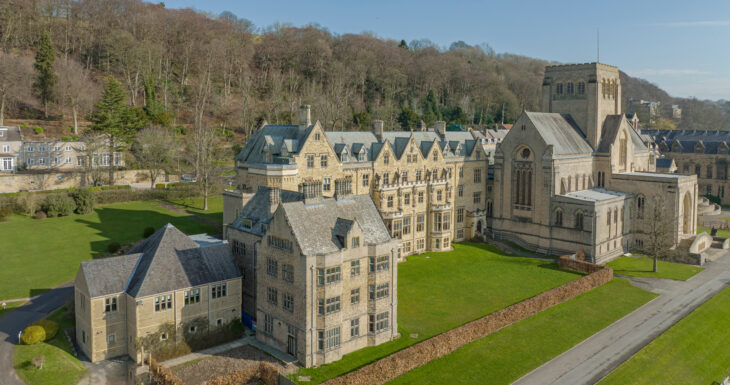
Ampleforth Abbey is also a major work by the distinguished 20th-century architect Sir Giles Gilbert Scott. The Abbey Church is a Grade 1 listed building, designed by Scott and built in two phases, from 1922 to 1924 and 1958 to 1961.