
The Attingham Summer School Guidebook
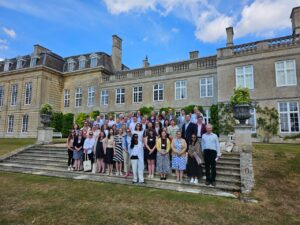
Historic Houses’ 2025 Attingham Scholar, Matthew Wood, curator at Castle Howard, shares his reflections on his Attingham experience.
My great-grandparents, Gib and Edith, were Northumbrian farmers. Each year, in the last week of May, they would set off on a two-week holiday and visit numerous ‘stately homes’, from Althorp and Athelhampton to Waddesdon and Woburn. They would form an itinerary using handbooks like ‘Historic Houses, Castles, and Gardens’, an annual index of all the sites regularly, and newly, opened to the public once the gilt had worn off the gingerbread and houses had to open, or re-open, their doors to cover upkeep and restoration in the post-war period. Along the way the pair amassed photographs and postcards, carefully pasted into large albums, and a glut of guidebooks.
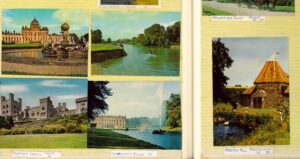
At about the age of 10 I unearthed these guidebooks and began to read them cover to cover (often under the covers), devouring their contents. I learned then, and found I still remember now, that the date of 1588 above the door to the Paved Room at Hardwick Hall is ‘misleading, because the house was not begun until three years later’, and that the Corinthian Arch at Stowe House is ‘an elementary but effective design’ executed by Lord Camelford in 1765. I couldn’t get enough and, armed with Christmas gifts of Historic Houses and National Trust membership, soon began coercing family members into visiting houses during my school holidays. Like a fictional character in a Du Maurier novel, the ‘stately home’ has since been ever present in my conscious and subconscious, and indeed forms the crux of my day-to-day as Curator at Castle Howard.
Having travelled vicariously through my great-grandparent’s guidebooks, I have recently returned from my own two-week journey around ‘the stately homes of England’, in the form of The Attingham Trust Summer School. Begun in 1952, the course is aimed at heritage professionals from around the world and examines country houses, their collections, and their settings. It is, in some respects, a rite of passage, and is the academic benchmark synonymous with this area of study.
There is no Attingham Summer School Guidebook, but suffice it to say the course is a complete immersion into the country house. Lead this year by David Adshead and Tessa Wild, it consists of an intense programme of 26 visits to houses, on and off the beaten track, in Buckinghamshire, Derbyshire, Northamptonshire, Nottinghamshire, Oxfordshire, and Sussex (the exact itinerary changes each year), supported by 20 lectures delivered by experts in the field. The two would often overlap. For example, as well as both delivering lectures, we had the benefit of Annabel Westman’s insight into the 16th century tapestries and 18th century bed hangings at Hardwick Hall, and Patricia Ferguson’s expertise on the panoply of porcelain at Burghley House.
It was incredible see houses and items which I had sometimes only read about; the Beauties in, and the beauty of, Petworth House; Reynold’s perfect portrait of Georgiana, 5th Duchess of Devonshire and daughter ‘Little G’, the future 6th Countess of Carlisle and chatelaine of Castle Howard, hanging in a Drawing Room at Chatsworth; the Axminster carpet immortalising Tilly Losch’s wet footprints at West Dean. Sometimes, they were places I had seen only on-screen (we’re no stranger to ‘set jetters’ at Castle Howard). This included Flintham Hall, where the Great Exhibition inspired Conservatory ranks along stars such as Kirstin Scott Thomas in ‘Easy Virtue’, and Drayton House, where Barry Keoghan memorably danced down the enfilade to Sophie Ellis-Bextor’s Murder on the Dancefloor in ‘Saltburn’.
The level of access afforded was incredible. We toured houses from top to bottom, with more doors opening to reveal more treasures at every turn. These were often private visits and thus the synonymous red ropes could be, and would be, crossed to closer examine an object and foster our own specialisms. There is photographic evidence of me and another scholar on our backs beneath one of the magnificent, mermaid-armed Linnel sofas in the Drawing Room at Kedleston Hall to look at their construction. We would, in some cases, have guided study or handling sessions lead by experts such as David Taylor and Yannick Chastang, who provided incredible insights. Tours were led by curators whose expertise and passion was infectious, or indeed owners for which the same might be said – here I think particularly of the brilliant tour of Boughton House given by the Duke of Buccleuch and our wonderful visit to Parham House with James and Lady Emma Barnard.
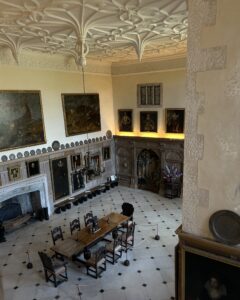
Parham’s Great Hall
Seeing these houses and landscapes so comprehensively allowed one to both understand and compare them with others in the itinerary. At Chatsworth House the layout of the baroque apartments has survived, whereas at Petworth House they had been altered and their functions changed. At Boughton the landscape is still populated by baroque canals and avenues, whereas at Kedleston Hall Robert Adam created a naturalistic ‘arcadian’ landscape. At Petworth House William Morris schemes were being applied to an earlier building, whereas at Standen we saw an uncompromised Arts and Crafts creation. Believe it or not, these were the sort of conversations we had on the coach as we motored from place to place.
I was one of 40 scholars, and the group were perhaps the most enriching element of the whole course. Even the 30-degree heat didn’t quash our spirits. Each brought different experience, different outlooks, and different expertise, but we were all united by the same interests. They have become a network of friends. What’s more, having run since 1952 there are 73 years’ worth of Attingham alumni, within which I can now count myself part of. As a 10-year-old reading dog-eared guidebooks I could scarce imagine one day being a part of such a cohort of country house fanatics!
As for being able to attend The Attingham Summer School, I am entirely indebted to Historic Houses, who selected me as their fully funded Historic Houses Scholar for 2025. I am also immensely grateful to the Nicholas and Victoria Howard, and Dr Christopher Ridgway, Chief Curator at Castle Howard, for their ceaseless support.
It is, occasionally, too easy to succumb to ‘castle fever’ and not see the world beyond Vanbrugh’s bastion walls – not least because the 3rd Earl of Carlisle and his successors brought the wonders of the world to Castle Howard in the form of follies and collected art and antiquities. Earlier this year we launched Castle Howard’s 21st Century Renaissance, a once-in-a-generation reimagining and representation of the house and collection, which as a Curator has been all encompassing. Therefore I can’t underscore the importance of the course in making me take a step back, to look at Castle Howard in the context of houses came before and followed, and the links between them. Sometimes these links were obvious – Arundel Castle, seat of the Duke of Norfolk, is the Howard family ‘mothership’ – whilst others could be found through similar pieces of furniture which raise questions of authorship. More on this anon.
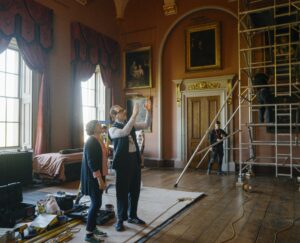
Matthew in action during Castle Howard’s 21st Century Renaissance.
Before attending the summer school, someone said one would evermore think of life as ‘pre and post Attingham’. Of course it was fanning the flames of an already burning passion, but I do feel like a light switch has been turned on in my head. To have been surrounded by such beauty and history is both extremely lucky and endlessly inspiring. Whilst I have reflected on the experience here, it will take some time for me to fully digest the course fully. In the meantime, there are 26 more guidebooks to join the others.
Applications for our 2026 Attingham Scholarship will open in late autumn 2025.